Warm decorating is less a palette than a way of making decisions. It asks you to choose fewer, better things and then let the room tell you what it needs next. That sounds unhurried, and it is. The reward is a home that still feels right long after the season's colour of the moment has moved on.
Start With the Light You Already Have
Before you buy a single cushion, spend a week noticing how daylight behaves in each room. Morning sun flatters almost everything, so a kitchen that looks wonderful before work can feel flat by evening. Rooms facing away from the sun hold cooler tones all day, which is why the same soft grey that feels calm in a sunlit room can read distinctly chilly in a room that rarely sees the sun.
The practical answer is to sample properly. Paint patches on several walls, at different heights, and look at them at the hours when you actually use the room. Leave them up for a few days. A colour that survives a rainy morning, a bright afternoon and the glow of a lamp at night is a colour worth committing to.
Build a Colour Story Rather Than a Colour Scheme
Schemes often come from a chart in a shop. Stories come from things you already love: a rug you have kept through several homes, a photograph, a piece of pottery, even the view from a window. Pull your colours from that source and they will agree with each other by default.
It helps to think in proportions rather than lists. Let the bulk of your walls and largest furniture pieces sit in a soft neutral, bring in a supporting tone through textiles and upholstery, then return to a deeper shade in smaller doses — a door frame, lamp base, or the binding on a sofa. When you want to refresh the room later, you can change the smaller doses without repainting everything.
Let Texture Carry the Warmth
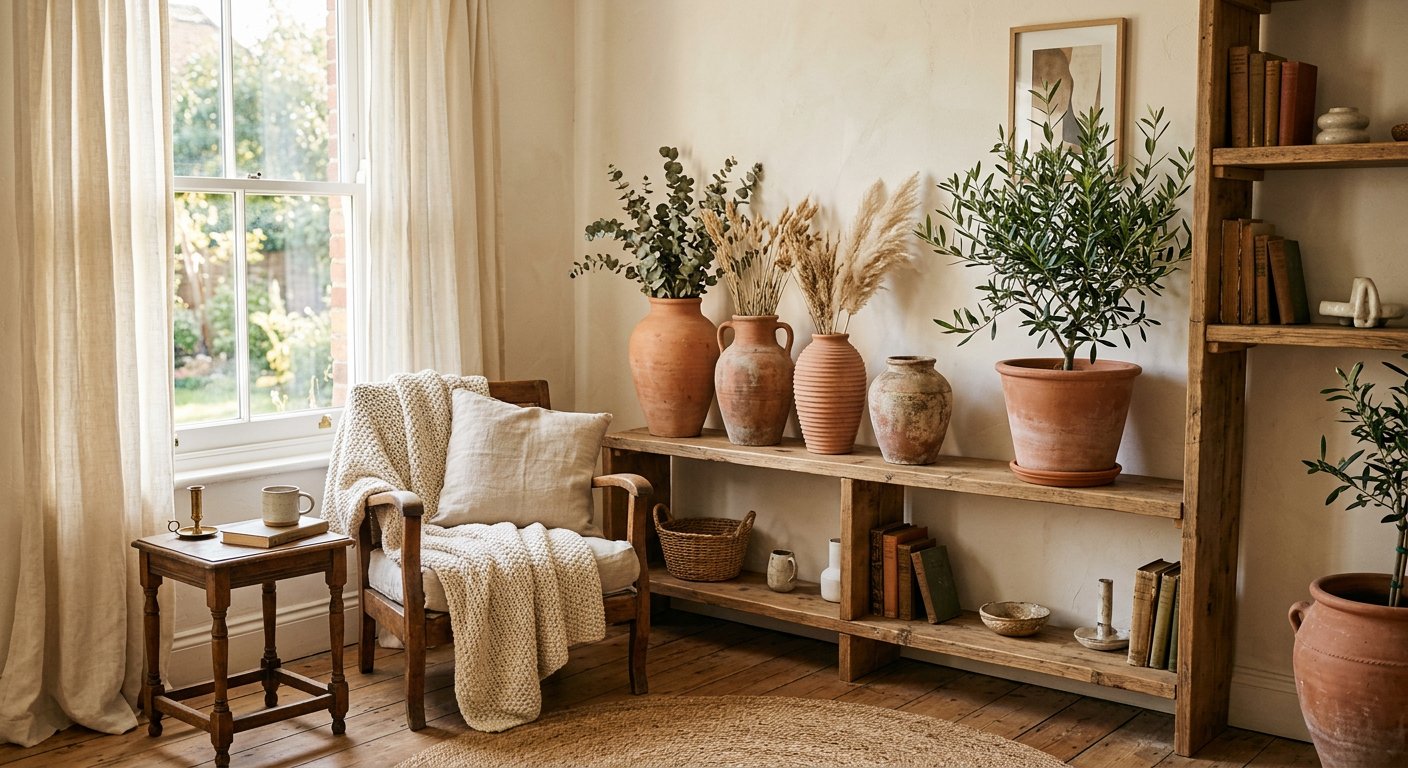
Warmth is felt as much as seen. Wool and linen, timber with visible grain, unglazed ceramics, jute underfoot and a little aged metal all soften a room in a way that colour alone cannot manage. Mixing matte surfaces with the occasional shine gives the eye somewhere to rest and stops a space feeling flat.
A room rarely needs more pattern. It needs contrast in scale and honesty in material — rough beside smooth, matte beside shine, old beside new.
Scale matters as much as texture. A single generous piece reads calmer than several smaller pieces clustered together, and an oversized artwork or mirror can quietly anchor a wall that has never quite worked. When in doubt, choose the larger object and give it space.
Leave Room for the Life You Actually Live
Decorating fails most often because every surface has been filled. Chairs need somewhere to be pushed back, tables need room for a laptop and a plate, shelves need gaps so the eye can rest. Treat empty space as part of the design rather than a problem still waiting to be solved.
Storage is the quiet partner of good decor. Deciding where post, chargers, toys and paperwork live will do more for the calm of a room than any styling arrangement. Baskets, closed drawers and a generous console near the door solve more real problems than a beautiful display ever will.
Buy Slowly and Live With Your Choices
There is no rush, and the best rooms usually show their history. A chair inherited from a family home sitting beside a new sofa, a table found secondhand and sanded back, a lamp that has moved house repeatedly — these pieces give a room a story that matching showroom furniture cannot.
Living with a gap for a while is genuinely useful. You learn what the space needs instead of guessing, and you avoid buying twice. When the right piece turns up, it fits because you waited for it rather than settling for whatever was available at the time.
Above all, let the room change with you. Warmer decorating is an ongoing conversation with your home, not a project with a finish line. Move a lamp when the evenings get longer, rotate artwork, change throws with the seasons, and edit rather than accumulate. That habit, more than any palette, is what makes a home feel unmistakably yours.